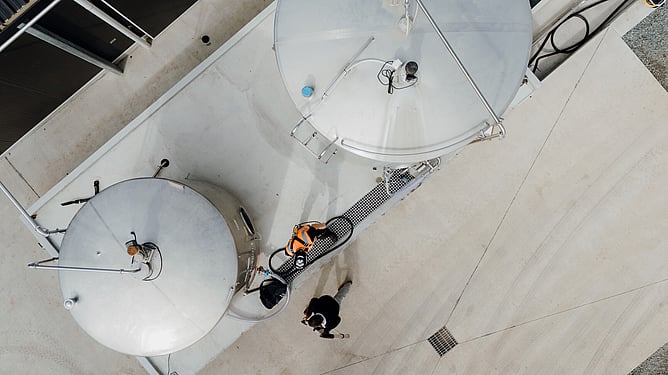
If you've been milking a while, you know the grading conversation usually starts with temperature. Hot day, hard-working chiller, watch the numbers. That's true, but it's not the whole story, and right now, at peak, the bigger driver of risk isn't the weather. It's volume.
A fault that was completely forgiving three months ago can be a genuine problem today, with the exact same equipment. Nothing's broken differently. What's changed is how much milk is sitting in the vat, how long it's exposed, and how much margin for error you've got left.
Why more milk means less room for error
Think about what a small fault actually does. A slightly slow agitator, a sensor that's drifted a degree or two, a cooling cycle that's a bit sluggish in July, with a half-full vat and a longer window before collection, these things barely register. The volume is lower, there's more headspace, and there's more time for the system to catch up before it matters.
At peak, none of that slack exists. The vat's fuller, closer to capacity, with less headspace and less margin. The same slow agitator now has more milk to move and less room to move it in. The same slight sensor drift is now sitting across a bigger volume, for longer, before the next collection. The fault hasn't gotten worse, the conditions around it have gotten less forgiving.
That's the shift that catches people out: the equipment feels the same, but the risk profile underneath it has completely changed.
The faults that matter most right now
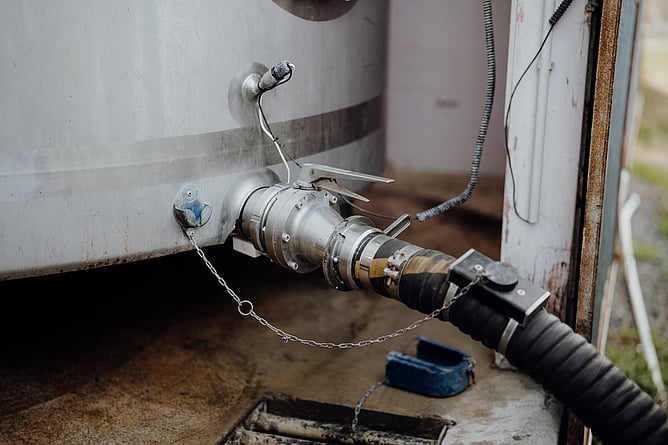
Agitator performance. A vat that's fuller for longer needs consistent, reliable agitation to avoid localised temperature variation, exactly what an underperforming agitator struggles to deliver.
Sensor accuracy. A reading that's slightly off matters more when it's the number you're trusting to confirm a full vat is safely at temperature before collection.
Cooling consistency. Longer fill times and bigger volumes mean more total hours of cooling per day, any inefficiency compounds simply because it's running more.
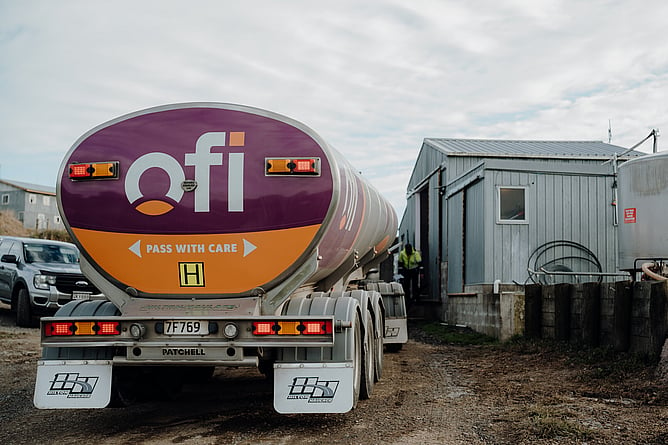
Collection timing pressure. With more milk moving through the system, there's less flexibility if a collection is delayed and a fault is quietly working against you in the meantime.
Why manual checks fall short at exactly the wrong time
The instinct is to check more often when volume's high, but peak season is also when everyone on farm has the least spare time to do it. Manual checks are a snapshot: accurate for the moment you look, and telling you nothing about the eight hours either side of it. At peak, a lot can happen in those eight hours.
What continuous visibility changes
Live monitoring doesn't get busier at peak the way people do. It's watching the vat the same way at 2pm and 2am, catching drift in agitator performance, temperature, and cooling cycles as it happens rather than at the next available moment someone can get out to check.
See faults form, not just fail. A gradual drift in performance shows up as a trend, well before it becomes a grading event.
No loss of coverage when staff are stretched. The system doesn't skip a check because everyone's flat out with milking and calving follow-up.
Alerts that account for volume. Know the moment something needs attention, rather than finding out at the next scheduled walk-through.
Peak isn't just the season of most milk. It's the season of least margin for the small stuff. Worth knowing which one you're carrying right now.

Get real-time visibility into agitator, temperature, and cooling performance... right when it matters most. Book a farm visit to see how Agora keeps watch through peak.

